
Drs. Lueckerath/Mona Lab
Nuclear Medicine Pre-Clinical Team
Our group focuses on theranostic approaches with the goal to deliver new insights into tumor biology, heterogeneity and metabolism and their relationship and relevance to functional imaging and biomarker-driven treatments in nuclear medicine.
Theranostics
Theranostics use radioligands that bind to cell surface receptors on target cells. Radioligands labeled with isotopes such as Gallium-68 enable imaging of target expression by positron emission tomography (PET). The same or a similar ligand labeled with alpha or beta radiation emitting isotopes (e.g., Actinium-225, Lead-212; Lutetium-177, Yttrium-90,) delivers therapeutic radiation specifically to target expressing tissues (radionuclide therapy; RNT). In contrast to conventional radiotherapy, RNTs are systemically administered; as a consequence, metastases throughout the body can be targeted, and tumors are irradiated for hours to days.
Research Focus
Radionuclide therapy is a promising treatment option for various cancers. However, outcomes are rarely curative. We address this clinical need by investigating the mechanisms underlying the limited effectiveness of RNT. These mechanisms include, for example, tumor cell intrinsic resistance mechanisms, tumor protection by microenvironmental factors, and a suboptimal radiotherapeutic strategy. Poor understanding of these mechanisms represents a key barrier to the development of more effective RNT approaches. To improve radionuclide therapy outcomes and to establish rationally chosen, translatable RNT-based combination therapies, we characterize cancer mouse models and patient samples, and use diverse in vitro, ex vivo, and in vivo analyses to identify targetable RNT-induced alterations in tumor, stroma and immune cells that mitigate the effects of RNT.
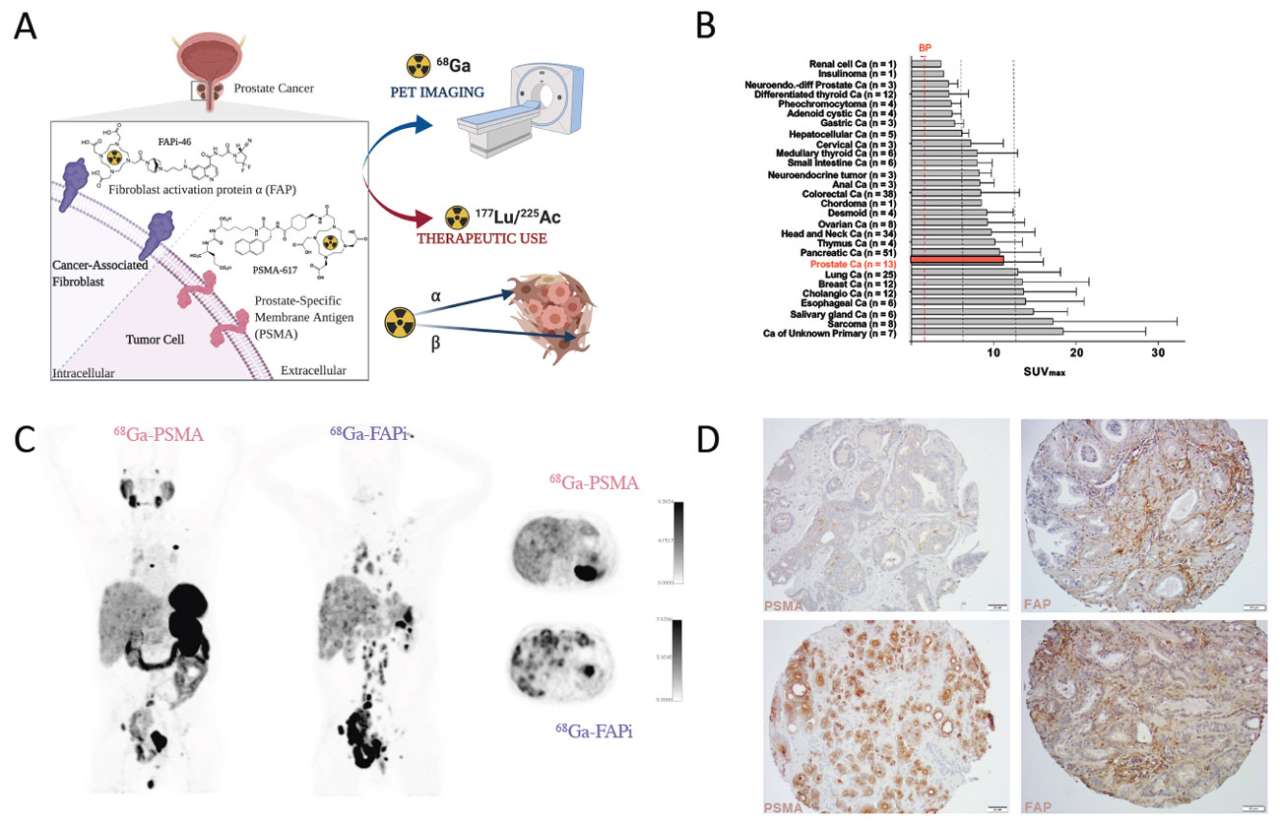
Basic principle of PSMA- and FAP-directed theranostics. (A) Gallium-68 labeled radioligands binding to PSMA (68Ga-PSMA) or FAP (68Ga-FAPi) can be used for PET imaging of PSMA and FAP positive tumors, respectively. Labeling of these radioligands with Lutetium-177 or Actinium-225 allows delivery of ionizing radiation specifically to PSMA and FAP expressing cells (radionuclide therapy). Both, PSMA- and FAP-ligands, bind with very high affinity to their target. (B) 68Ga-FAPi uptake (SUVMAX) in various cancers (mean ± SD). Vertical lines indicate SUVMAX cut-offs to define low (blood pool [BP] < x <6), intermediate (6 ≤ x <12) and high uptake (≥12) (adapted from Kratochwil et al., J Nucl Med. 2019;60(6):801-805). (C) 68Ga-PSMA-11 (left) and 68Ga-FAPi-46 (right) PET/computed tomography (CT) images of a mCRPC patient. Left and middle: 3D maximum intensity projections. Right: fused PET/CT axial view. (D) Representative histological images of a prostate cancer tissue microarray demonstrating PSMA (left) and FAP (right) expression (magnification 20x). Black bars represent 100 μm.
PSMA-targeted Theranostics
RNT targeting the prostate-specific membrane antigen (PSMA; 177Lu-/225Ac-PSMA) is an emerging treatment modality in metastatic prostate cancer. However, approximately half of the patients experience treatment failure despite tumor PSMA expression, and relapse occurs invariably. Using prostate cancer mouse models, we have uncovered various RNT resistance mechanisms including (i) low or heterogeneous PSMA expression resulting in insufficient tumor radiation dose delivery; (ii) suboptimal selection of radioisotopes (alpha vs. beta) for specific disease patterns; (iii) upregulated DNA damage and replication stress responses that can be addressed pharmacologically using clinically viable drugs; and (iv) genomic alterations such as inactivating mutations in the tumor suppressor gene TP53. Recently, we showed that combining RNT and PD-1 blockade can synergistically reduce prostate cancer burden, improve time to progression and survival, and may lead to generation of an immunological anti-tumor memory. Together, our translational research aims at providing solutions for inherent and acquired resistance to PSMA-targeted RNT that will allow clinicians to exploit the full potential of RNT for the benefit of patients with lethal prostate cancer.
Fibroblast activation protein-targeted theranostics: A new approach to modulate tumor-stroma interactions
Fibroblast activation protein (FAP) is a serine protease that is overexpressed on cancer-associated fibroblasts (CAFs), which can constitute >90% of tumor stroma, and sometimes on cancer cells. In malignant diseases, FAP expression has been associated with neoplastic transformation, tumor growth, neo-angiogenesis, metastatic potential, treatment resistance and immunosuppression. Using the new FAP-targeted PET probe 68Ga-FAPi which was developed by our collaborators (Prof. Uwe Haberkorn, University of Heidelberg), favorable dosimetry (i.e., high tumor to healthy organ ratio) was established across 28 different cancers. Our research aims at (i) establishing quantitative radiotherapeutic strategies for FAP-targeted RNT that significantly reduce tumor burden and improve survival in our murine cancer models; and (ii) investigating the alterations in signaling, metabolism and immune status triggered by FAP-targeted RNT with the goal to exploit these alterations by administering synergistically acting combination therapies.
We collaborate closely with Drs. Czernin and Calais in the Nuclear Medicine Clinic to clinically translate FAP-targeted theranostics for the characterization and treatment of difficult to treat malignancies marked by the presence of extensive tumoral and/or stromal FAP expression such as metastatic prostate cancer, pancreatic ductal adenocarcinoma, and sarcoma.

Katharina Lueckerath, PhD
Assistant Adjunct Professor, UCLA Molecular and Medical Pharmacology
Katharina is a biomedical scientist who obtained her PhD at the Institute for Tumor Biology and Experimental Therapy (Georg-Speyer-Haus, Frankfurt a. M., Germany). She served as head of the research group Experimental Oncology in Nuclear Medicine at the University of Würzurg (Germany) before transferring to UCLA.

Christine Mona, PhD
Assistant Adjunct Professor, UCLA Molecular and Medical Pharmacology
Christine received her Ph.D. in Pharmacology in 2016 from Université de Sherbrooke. She joined UCLA in 2016 as a Post-Doctoral Research Associate in Nuclear Medicine in the research group of Professor Johannes Czernin. In early 2020, Dr. Mona was promoted to Adjunct Assistant Professor at the Ahmanson Translational Theranostic Division (ATTD). Dr. Mona is a translational researcher at the edge of Chemistry, Pharmacology and Nuclear Medicine.

Marco Taddio, PhD
Postdoctoral Fellow
Marco received his doctorate in 2019 at ETH Zurich and has recently moved from Switzerland to the United States to join our group as a postdoctoral researcher. He has a strong interest in translational oncology and immunology. His expertise covers a broad field of preclinical research from organic chemistry, over various in vitrotechniques to radiolabeling and in vivostudies.

Kyle Current
Senior Research Associate
Kyle obtained his B.A. in Biochemistry from the University of North Texas. Post University, he gained experience in antibody engineering while at both the UT Southwestern Medical Center and Texas A&M University, respectively. Currently at UCLA his research interests include studying metastatic prostate cancer using radiation, immunotherapeutics and small molecule drug approaches.
Firas Hikmat
Research Associate
Firas immigrated to the United States in 2013 in pursuit of becoming a physician. In 2019 he received his B.S. in Biology from UCLA. Throughout Firas’ undergraduate education his focus was directed towards gaining clinical and research experience in multidisciplinary areas. Currently he is working as a Staff Research Associate with Drs. Mona and Lueckerath while in the process of applying to medical schools.
Joel Almajano
Lab Manager
Selected Recent Publications:
- Czernin J, Current K, Mona CE, Nyiranshuti L, Hikmat F, Radu C, Lueckerath K. Immune-Checkpoint Blockade Enhances 225Ac-PSMA617 Efficacy in a Mouse Model of Prostate Cancer. JNM (accepted for publication, 06/2020)
- Brouillette RL, Besserer-Offroy É, Mona CE, Chartier M, Lavenus S, Sousbie M, Belleville K, Longpré JM, Marsault É, Grandbois M, Sarret P. Cell-penetrating pepducins targeting the neurotensin receptor type 1 relieve pain. Pharmacol Res. 2020 May;155:104750. doi: 10.1016/j.phrs.2020.104750. Epub 2020 Mar 6. PMID: 32151680
- Stuparu AD, Meyer CAL, Evans-Axelsson SL, Lückerath K, Wei LH, Kim W, Poddar S, Mona CE, Dahlbom M, Girgis MD, Radu CG, Czernin J, Slavik R. Targeted alpha therapy in a systemic mouse model of prostate cancer – a feasibility study. 2020;10(6):2612-2620. doi: 10.7150/thno.42228. eCollection 2020. PubMed PMID: 32194823; PubMed Central PMCID: PMC7052903.
- Current K, Meyer C, Magyar CE, Mona CE, Almajano J, Slavik R, Stuparu AD, Cheng C, Dawson DW, Radu CG, Czernin J, Lueckerath K. Investigating PSMA-Targeted Radioligand Therapy Efficacy as a Function of Cellular PSMA Levels and Intratumoral PSMA Heterogeneity. Clin Cancer Res. 2020 Jan 13; doi: 10.1158/1078-0432.CCR-19-1485. Epub ahead of print PubMed PMID: 31932492; NIHMSID: NIHMS1549816.
- Lückerath K, Wei L, Fendler WP, Evans-Axelsson S, Stuparu AD, Slavik R, Mona CE, Calais J, Rettig M, Reiter RE, Herrmann K, Radu CG, Czernin J, Eiber M. Preclinical evaluation of PSMA expression in response to androgen receptor blockade for theranostics in prostate cancer. EJNMMI Res. 2018 Oct 29;8(1):96. doi: 10.1186/s13550-018-0451-z. PubMed PMID: 30374743; PubMed Central PMCID: PMC6206308.
- Lückerath K, Stuparu AD, Wei L, Kim W, Radu CG, Mona CE, Calais J, Rettig M, Reiter RE, Czernin J, Slavik R, Herrmann K, Eiber M, Fendler WP. Detection Threshold and Reproducibility of 68Ga-PSMA11 PET/CT in a Mouse Model of Prostate Cancer. J Nucl Med. 2018 Sep;59(9):1392-1397. doi: 10.2967/jnumed.118.207704. Epub 2018 Mar 30. PubMed PMID: 29602819; PubMed Central PMCID: PMC6910618.
- Fendler WP, Stuparu AD, Evans-Axelsson S, Lückerath K, Wei L, Kim W, Poddar S, Said J, Radu CG, Eiber M, Czernin J, Slavik R, Herrmann K. Establishing 177Lu-PSMA-617 Radioligand Therapy in a Syngeneic Model of Murine Prostate Cancer. J Nucl Med. 2017 Nov;58(11):1786-1792. doi: 10.2967/jnumed.117.193359. Epub 2017 May 25. PubMed PMID: 28546332; PubMed Central PMCID: PMC6944167.
- Lapa C, Herrmann K, Schirbel A, Hänscheid H, Lückerath K, Schottelius M, Kircher M, Werner RA, Schreder M, Samnick S, Kropf S, Knop S, Buck AK, Einsele H, Wester HJ, Kortüm KM. CXCR4-directed endoradiotherapy induces high response rates in extramedullary relapsed Multiple Myeloma. 2017;7(6):1589-1597. doi: 10.7150/thno.19050. eCollection 2017. PubMed PMID: 28529638; PubMed Central PMCID: PMC5436514.
- Lapa C, Schreder M, Schirbel A, Samnick S, Kortüm KM, Herrmann K, Kropf S, Einsele H, Buck AK, Wester HJ, Knop S, Lückerath K. [68Ga]Pentixafor-PET/CT for imaging of chemokine receptor CXCR4 expression in multiple myeloma – Comparison to [18F]FDG and laboratory values. 2017;7(1):205-212. doi: 10.7150/thno.16576. eCollection 2017. PubMed PMID: 28042328; PubMed Central PMCID: PMC5196897.
- Mona CE, Besserer-Offroy É, Cabana J, Leduc R, Lavigne P, Heveker N, Marsault É, Escher E. Design, synthesis, and biological evaluation of CXCR4 ligands. Org Biomol Chem. 2016 Nov 2;14(43):10298-10311. doi: 10.1039/c6ob01484d. PMID: 27752700
- Mona CE, Besserer-Offroy É, Cabana J, Lefrançois M, Boulais PE, Lefebvre MR, Leduc R, Lavigne P, Heveker N, Marsault É, Escher E. Structure-Activity Relationship and Signaling of New Chimeric CXCR4 Agonists. J Med Chem. 2016 Aug 25;59(16):7512-24. doi: 10.1021/acs.jmedchem.6b00566. Epub 2016 Aug 11. PMID: 27434274
- Herrmann K, Schottelius M, Lapa C, Osl T, Poschenrieder A, Hänscheid H, Lückerath K, Schreder M, Bluemel C, Knott M, Keller U, Schirbel A, Samnick S, Lassmann M, Kropf S, Buck AK, Einsele H, Wester HJ, Knop S. First-in-Human Experience of CXCR4-Directed Endoradiotherapy with 177Lu- and 90Y-Labeled Pentixather in Advanced-Stage Multiple Myeloma with Extensive Intra- and Extramedullary Disease. J Nucl Med. 2016 Feb;57(2):248-51. doi: 10.2967/jnumed.115.167361. Epub 2015 Nov 12. PubMed PMID: 26564323.
- Lapa C, Knop S, Schreder M, Rudelius M, Knott M, Jörg G, Samnick S, Herrmann K, Buck AK, Einsele H, Lückerath K. 11C-Methionine-PET in Multiple Myeloma: Correlation with Clinical Parameters and Bone Marrow Involvement. 2016;6(2):254-61. doi: 10.7150/thno.13921. eCollection 2016. PubMed PMID: 26877783; PubMed Central PMCID: PMC4729773.
- Lückerath K, Lapa C, Albert C, Herrmann K, Jörg G, Samnick S, Einsele H, Knop S, Buck AK. 11C-Methionine-PET: a novel and sensitive tool for monitoring of early response to treatment in multiple myeloma. 2015 Apr 10;6(10):8418-29. doi: 10.18632/oncotarget.3053. PubMed PMID: 25762625; PubMed Central PMCID: PMC4480763.
- Philipp-Abbrederis K, Herrmann K, Knop S, Schottelius M, Eiber M, Lückerath K, Pietschmann E, Habringer S, Gerngroß C, Franke K, Rudelius M, Schirbel A, Lapa C, Schwamborn K, Steidle S, Hartmann E, Rosenwald A, Kropf S, Beer AJ, Peschel C, Einsele H, Buck AK, Schwaiger M, Götze K, Wester HJ, Keller U. In vivo molecular imaging of chemokine receptor CXCR4 expression in patients with advanced multiple myeloma. EMBO Mol Med. 2015 Apr;7(4):477-87. doi: 10.15252/emmm.201404698. PubMed PMID: 25736399; PubMed Central PMCID: PMC4403048.
- Lückerath K, Kirkin V, Melzer IM, Thalheimer FB, Siele D, Milani W, Adler T, Aguilar-Pimentel A, Horsch M, Michel G, Beckers J, Busch DH, Ollert M, Gailus-Durner V, Fuchs H, Hrabe de Angelis M, Staal FJ, Rajalingam K, Hueber AO, Strobl LJ, Zimber-Strobl U, Zörnig M. Immune modulation by Fas ligand reverse signaling: lymphocyte proliferation is attenuated by the intracellular Fas ligand domain. 2011 Jan 13;117(2):519-29. doi: 10.1182/blood-2010-07-292722. Epub 2010 Oct 22. PubMed PMID: 20971954.